Six countries, six different histories of war and neutrality
Which countries have had the fewest wars? A meaningful answer needs a period and a definition of participation. A country can avoid fighting on its own territory while sending forces abroad. A neutral state can have a history of civil war. Abolishing a standing army changes an institution at a particular moment.
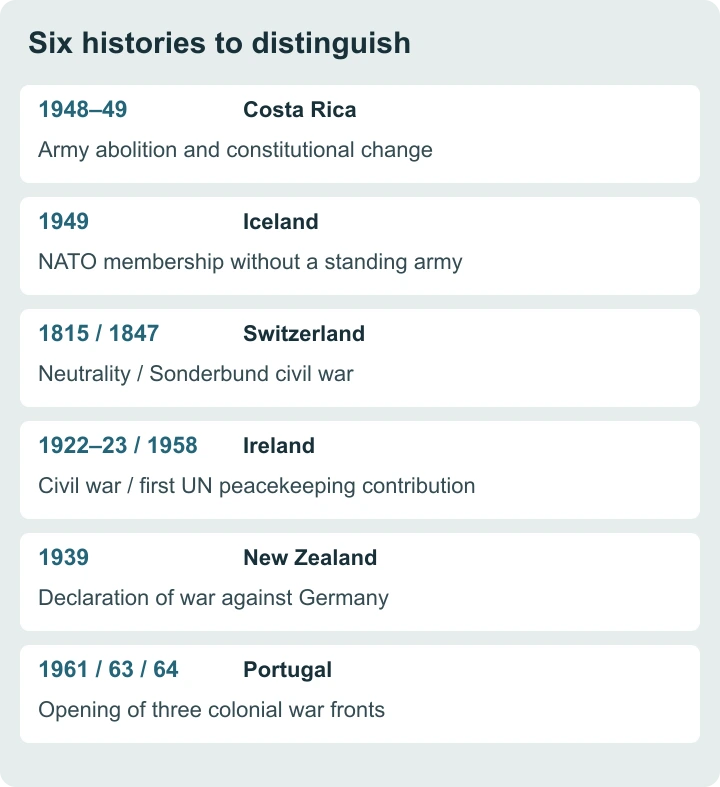
Costa Rica, Iceland, Switzerland, Ireland, New Zealand and Portugal illustrate six different histories behind the question. Each case focuses on a dated event or policy and explains how it changes the comparison. Together they provide historical context for evaluating claims about unusually peaceful countries.
Costa Rica — a dated decision to abolish the permanent army
On December 1, 1948, José Figueres Ferrer marked the abolition of the army at the Bellavista barracks. Costa Rica’s National Museum describes the symbolic ceremony, including his blow to part of the building with a hammer. The barracks became the museum’s home.
The constitutional settlement followed in 1949. Article 12 prohibits the army as a permanent institution and provides for the police forces needed to maintain public order. The wording matters because the institutional achievement concerns the permanent army. It does not describe the disappearance of every security function.
For a historical comparison, use December 1948 and the 1949 Constitution as turning points. A claim about the country after those changes needs its own time interval. Applying the later arrangement backwards would erase the very transition that makes the case significant.
Costa Rica therefore offers a concrete example of changing how a state organizes security. A list based only on whether a country possesses a standing army would capture that fact, but it would answer a narrower question than a count of wars throughout its history.
Iceland — no standing army, but a strategic defence role
Iceland became a founding NATO member in 1949 despite having no standing armed forces. NATO’s historical account places that choice against its wartime experience. British forces occupied Iceland during the Second World War, and the Icelandic government subsequently invited the United States to take over its defence. The republic was established in 1944.
NATO also records the bilateral defence agreement with the United States dating from 1951. The combination demonstrates why the absence of a national army does not by itself describe a country’s strategic position. Location, agreements and the presence of allied forces can be central to defence policy.
An army-based comparison would classify Iceland differently from a comparison of alliance commitments. A study of foreign military presence would ask a third question. None of those categories can simply be substituted for the number of wars in which the state participated.
Switzerland — international neutrality and an internal civil war
Switzerland’s neutrality received international recognition in 1815. The Swiss Federal Department of Foreign Affairs describes neutrality as a central element of its foreign policy and identifies the Hague framework of 1907 as a further formalisation of its obligations.
The same country experienced the Sonderbund War in 1847. The federal authorities’ historical account describes a conflict between conservative Catholic cantons and radical liberal cantons, ending in a liberal victory within weeks. The federal state followed in 1848.
These dates explain a common misunderstanding. Neutrality concerns a state’s position in conflicts between other states. Domestic disputes about political authority can still become armed conflicts. Counting only foreign wars would miss an episode that was central to the formation of modern Switzerland.
The useful historical question is therefore how external neutrality and internal state-building developed together. The civil war’s existence does not make the neutrality dates meaningless. It establishes that the two records concern different kinds of conflict.
Ireland — neutrality, civil conflict and peacekeeping
Ireland’s Department of Foreign Affairs describes military neutrality in terms of its relationship to military alliances and mutual defence arrangements. That policy has existed alongside overseas peace-support activity.
The Defence Forces record the first Irish contribution to UN peacekeeping in 1958, when officers served as observers in Lebanon. An armed contingent subsequently served in the UN operation in the Congo from 1960 to 1964. These deployments are specific historical commitments, each with its own mandate.
Ireland also experienced civil war in 1922–1923. The University College Cork Civil War Fatalities Project examines that conflict through a defined historical period and case records. It is a separate subject from the later development of military neutrality and UN service.
A comparison should keep those categories visible. Listing a peacekeeping deployment as an offensive war merely because troops were abroad would discard the mission’s purpose and mandate. Treating neutrality as evidence that the country never experienced armed conflict would discard its domestic history.
New Zealand — geographical distance and overseas participation
New Zealand formally declared war on Germany on September 3, 1939. The Ministry for Culture and Heritage explains that it acted in its own right and treated the state of war as beginning at the same moment as Britain’s, despite the difference in local clocks.
The ministry connects the decision with opposition to fascist expansion, reliance on British power for security, economic relationships and the ties many New Zealanders felt to Britain. Geographical distance from Europe did not remove those connections.
This example exposes the difference between the location of fighting and participation in a war. A map of battles on national territory and a record of a government’s wartime commitments can produce different pictures. For New Zealand, an account that considered only the former would leave out a major part of its twentieth-century history.
Portugal — the overseas conflicts that a European map leaves out
Portugal’s colonial wars included fighting in Angola, Guinea and Mozambique. The historical chronology presented by Portuguese public broadcaster RTP traces the opening of these fronts to 1961, 1963 and 1964 respectively. The campaigns extended across much of the 1960s and into the 1970s.
A comparison limited to fighting inside Portugal’s present-day European territory would miss those campaigns. That omission would be particularly serious if the resulting list claimed to describe Portugal’s total participation in war.
The names of the territories and conflicts also need historical context. Portuguese military records may use the language of overseas campaigns, while accounts of the independence movements describe liberation struggles. Identify the place, dates and parties before deciding whether two differently named entries refer to the same conflict.
Portugal’s inclusion here is a test of the comparison itself. Any method that makes extensive overseas fighting disappear solely because it occurred outside today’s national borders is poorly suited to measuring a state’s wartime involvement.
What the six histories actually establish
| Country | Documented anchor | Question to keep separate |
|---|---|---|
| Costa Rica | 1948 abolition ceremony and 1949 constitutional settlement | Army organization versus the whole historical record |
| Iceland | NATO membership from 1949 without a standing army | National military institutions versus defence arrangements |
| Switzerland | Neutrality recognised in 1815, civil war in 1847 | External neutrality versus domestic conflict |
| Ireland | Civil war in 1922–1923, UN peacekeeping from 1958 | Internal war versus later policy and overseas missions |
| New Zealand | Declaration of war on September 3, 1939 | Battlefield location versus state participation |
| Portugal | Colonial fighting in three African theatres | Present-day borders versus overseas involvement |
How to count wars without changing the question halfway through
Start with one sentence that fixes the period, the type of conflict and the unit counted. For example, a study might count state-based armed conflicts involving a government’s forces during a specified period. It would then need a dataset that records the required participation, including involvement beyond national borders.
The Uppsala Conflict Data Program defines a state-based armed conflict using an incompatibility over government or territory, organized armed force involving at least one state government, and at least 25 battle-related deaths in a calendar year. That threshold defines qualifying armed conflict for the dataset. Applying it requires the codebook, coverage dates and the relevant actor fields.
Even a clearly defined dataset leaves a choice between distinct conflicts and conflict-years. In a constructed example, one qualifying conflict remains active for five years. It contributes one distinct conflict or five conflict-years. Neither total is an arithmetic error. They describe incidence and duration differently.
- Write down how foreign deployments, changes of borders and newly independent states will be handled before calculating totals.
- Record missing evidence separately from a confirmed zero.
These rules prevent a short observation period or an excluded territory from silently turning into a claim of exceptional peacefulness.
For these six countries, the strongest conclusion is historical. Different institutional choices and patterns of participation produce different kinds of distance from war. Understanding those differences provides a more informative answer than assigning an unsupported lifetime league position.