What a social worker can help with—and how to turn a referral into support
A social worker can help connect a personal difficulty with the practical services, relationships and institutions that affect it. The work may involve assessment, coordination, advocacy, family support or clinical care, depending on the setting and professional qualifications. The useful starting question is: what can this particular service do about the problem that matters most to you?
This guide uses US professional descriptions, while the planning examples are illustrative. Job titles, eligibility, licensing and confidentiality requirements vary by location. A social worker cannot guarantee that another agency will approve an application or immediately create a service that has no capacity.
The profession includes several kinds of work
The National Association of Social Workers describes practice in schools, hospitals, community organizations, public agencies and other settings. It includes work with individuals as well as administration, research, policy and community organizing. A person who helps coordinate hospital discharge may have a different role from a therapist or a school social worker.
The Bureau of Labor Statistics distinguishes clinical social work from other roles. In the United States, clinical social workers need a master’s degree, supervised clinical experience and state licensure. Exact titles and requirements vary. Asking about credentials is appropriate when you are seeking a specific kind of treatment.
| Situation | Possible contribution | Question to ask |
|---|---|---|
| Leaving hospital with practical difficulties at home | Assess barriers and coordinate with relevant services | Who confirms that support is available before the transition? |
| Repeated school absence linked to family difficulties | Explore barriers with the student, family and school | How will the student’s priorities be included? |
| A need for psychotherapy | Clinical care from an appropriately qualified professional | What treatment and licensing apply here? |
| Several families encounter the same application barrier | Research or advocacy for an organizational change | How can the pattern be documented without exposing personal details? |
Describe the problem in a way someone can act on
Prepare a short account of the immediate difficulty, any deadline and the outcome you hope to achieve. “I need help with everything” may describe the feeling accurately, but a first step becomes easier when the most urgent barrier is visible.
For example: “I have an appointment next Tuesday, but the transport I normally use is unavailable. I also received a benefits letter I do not understand. I would like to deal with the appointment first, then work out what the letter requires.” This gives the worker a sequence without assuming that both problems belong to the same agency.
- Bring relevant letters, dates and contact details if available.
- Explain when missing paperwork, reading difficulties, language or lack of internet access is part of the problem.
- Ask which documents are essential and whether alternatives are accepted; do not assume you must assemble a perfect file before making contact.
An assessment should include strengths and constraints
The NASW ethical framework places individual well-being in a social context. In practice, that means the conversation should consider the person’s goals and available support as well as the difficulty itself. A plan that depends on a car, smartphone or available family member is not practical if the person has none.
Ask what the service can offer directly, what it can request from another organization and what remains outside its authority. Also identify what you can comfortably do yourself. Assistance should make the next action achievable, not replace your priorities with an unexplained professional checklist.
A worked example: from three problems to one coordinated plan
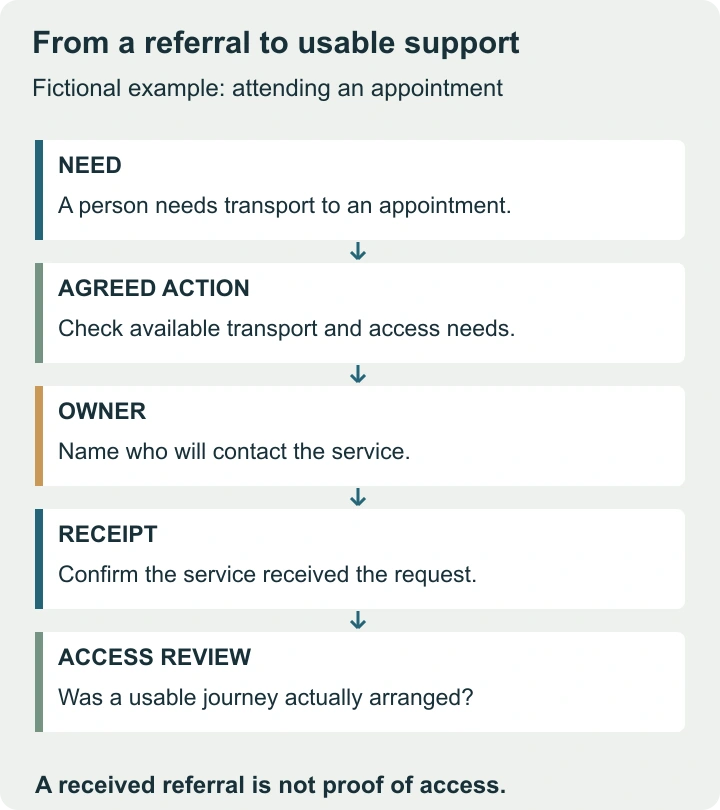
Consider a fictional adult preparing to return home after treatment. They need transport to a follow-up visit, help understanding a support application and a way to obtain groceries during recovery. A referral list containing ten organizations would not show whether any of those needs had actually been met.
| Need | Agreed action | Owner | Evidence of completion |
|---|---|---|---|
| Transport to the appointment | Check the relevant transport service and confirm booking requirements | Named service team, with the person’s agreement | Journey confirmed, or an alternative discussed |
| Application letter | Identify the deadline and missing information | Person and worker together | Required response understood and submitted if appropriate |
| Groceries during recovery | Explore available support and delivery constraints | Agreed contact | The person knows how the first order or delivery will happen |
The plan separates a request from a result. “Referral sent” is a useful intermediate milestone, but it is not equivalent to transport booked or food obtained. Where another agency must decide eligibility, the plan should state how the person will learn that decision and what happens if the answer is no.
It also avoids assigning everything to the person who is already overwhelmed. A task needs both an owner and a feasible method. If the person cannot use the online form, “complete the form online” is an unresolved barrier, not a completed plan.
Ask how information and consent will work
Before sensitive information is shared, ask what will be recorded, why another service needs it and who may receive it. Confidentiality has limits that depend on the service and applicable rules. Request a plain-language explanation rather than assuming either absolute secrecy or unrestricted sharing.
A practical question is: “What would you need my permission to share, and when might you have to share information without it?” If a form authorizes communication between agencies, ask which agencies, which information and what duration it covers. A worker should be able to explain the process or identify the appropriate person to do so.
A support person can help remember the discussion, but their presence should be agreed. Clarify whether you want them involved throughout or only for part of the meeting. If written notes or phone messages could create difficulties at home, explain your safe contact preferences to the service.
Make the handoff observable
A supported handoff may involve the worker explaining the need to the receiving team, helping arrange the next conversation or checking that the referral was received, subject to appropriate consent. Ask which of those steps will actually happen. The phrase “we have referred you” can otherwise conceal several different processes.
Keep a small action record: date, team, purpose, next step and expected response. Use the support action-plan worksheet if it helps. Store sensitive records somewhere appropriate for your circumstances rather than placing them in a shared folder by default.
For example, “Housing team will review the documents by the agreed date; if no response arrives, contact the named office using the reference number” is easier to follow than “wait for someone to call.” The actual timeframe must come from the service; this guide does not invent one.
If the first route fails, identify the reason
A missed contact, an incomplete application, lack of eligibility and lack of service capacity are different obstacles. Ask which one occurred. A clearer explanation may identify a correction, another appropriate route or a review process, but it does not guarantee a successful outcome.
Repeat your immediate priority if the conversation drifts. “I understand the longer application will take time; what can we establish now about next week’s appointment?” keeps the plan grounded. If there is immediate danger or a medical emergency, use the appropriate emergency service instead of waiting for a routine referral.
The practical value of social work is often visible in these small transitions: a need is understood, an unrealistic assumption is removed, responsibility becomes clear and a person can take the next step. Good coordination is measured by whether support becomes usable, not simply by how many organizations appear on a list.