Gas leaks and carbon monoxide: emergency actions and a practical home safety plan
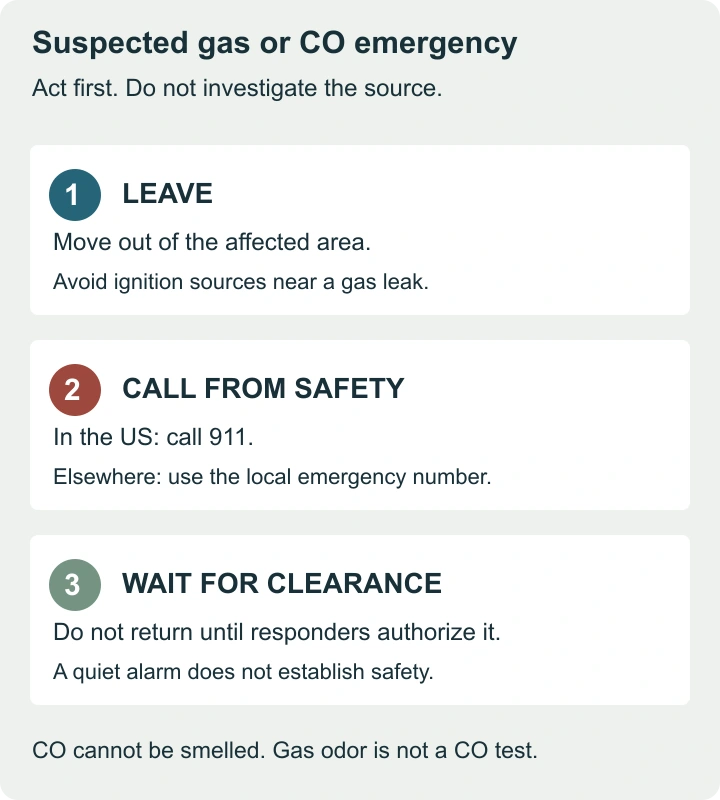
If you suspect a fuel-gas leak, a carbon monoxide emergency or CO poisoning, leave the affected area immediately and call 911 from a safe location in the United States. Outside the US, use the local emergency number. Do not remain inside to find the source. Near a suspected fuel-gas leak, avoid electrical switches, plugs, phones, vehicle ignition and other possible ignition sources.
The rest of this guide is for preparation after you are safe. It summarizes US public guidance from PHMSA, CPSC and CDC. It does not provide instructions for adjusting a gas appliance, testing a suspected leak yourself or deciding when a building is safe to re-enter.
Fuel gas and carbon monoxide are different hazards
A combustible fuel-gas leak can create a fire or explosion risk. Carbon monoxide is a poisonous gas associated with fuel combustion; it has no color or smell. An odor added to a fuel-gas supply does not make CO detectable by smell.
| Concern | Possible warning | Important distinction |
|---|---|---|
| Escaping fuel gas | An unusual gas odor, hissing or another suspected leak sign | Absence of an odor is not a universal safety test |
| Carbon monoxide | A CO alarm or symptoms consistent with exposure | CO itself cannot be smelled |
| Smoke or fire | Smoke, fire or the relevant alarm | A smoke alarm does not automatically detect CO or fuel gas |
Combination alarms exist, but the detection functions must be confirmed on the actual product. A device labeled for CO should not be assumed to detect natural gas, propane or every airborne hazard. The label and instructions matter more than the device’s shape or its location on a wall.
Make the emergency response simple
PHMSA advises leaving a suspected leak area on foot, avoiding ignition sources and calling from safety. Do not operate pipeline valves or attempt to locate the escaping gas. Do not use an automatic garage door or start a nearby vehicle as part of leaving the affected area.
For a CO alarm or suspected poisoning, move into fresh air and obtain emergency assistance. CPSC and CDC identify symptoms including headache, dizziness, weakness, nausea and confusion. Symptoms may resemble other illnesses; do not use that resemblance to dismiss a possible exposure. Tell responders if anyone may still be inside or needs medical help.
Wait for the appropriate responders to authorize re-entry. Feeling better outside, an alarm becoming quiet or opening a window does not establish that the cause has been corrected. Do not go back for possessions or to silence equipment while the incident is being assessed.
Three situations where the wrong shortcut adds risk
| Situation | Tempting shortcut | Safer priority |
|---|---|---|
| A gas smell near the kitchen | Turn on the light and inspect connections | Leave without creating an ignition source; call from safety |
| A CO alarm sounds but nobody smells anything | Assume the alarm is mistaken | Treat the warning seriously; get outside and request help |
| A generator is needed during an outage | Run it in an open garage to keep it dry | Use only an appropriate outdoor arrangement; an open garage is not safe |
These are response examples, not ways to diagnose an installation. If you cannot identify the safe next step during an incident, prioritize leaving and contacting emergency services rather than experimenting with a detector, appliance or ventilation arrangement.
Prepare alarms according to their actual instructions
CPSC recommends CO alarms on every level of the home and outside sleeping areas, with battery operation or battery backup. Follow the product’s installation, testing and replacement instructions and applicable local requirements. Installation height, signal patterns and service life should not be guessed from another model.
Keep a simple inventory:
- location,
- manufacturer,
- model,
- installation date,
- replacement information
- and the date of the most recent test performed as instructed.
Record which person is responsible for a rental or shared property. A note saying “alarm present” does not establish that it has appropriate power or is within its service life.
Learn the difference between the model’s emergency signal and its maintenance indicators while reading the instructions in normal conditions. During a suspected emergency, do not stay in the affected area trying to decode a sound. Address recurring signals through the proper process rather than disabling an inconvenient device.
Portable generators require outdoor separation
CPSC advises operating portable generators outdoors, at least 20 feet from homes, with the exhaust directed away. That is approximately 6.1 metres. Never run one inside a home, garage, basement or other enclosed or partly enclosed space, even with doors and windows open.
Plan the location before an outage. Consider openings and neighboring occupied buildings, and follow the equipment instructions. If the available space does not permit a safe arrangement, do not substitute a nearer window, balcony or garage. Seek an appropriate alternative rather than treating the stated distance as a suggestion that can be negotiated indoors.
Keep the CO question separate from electrical connection and weather-protection questions. A location that addresses one risk does not establish that the whole setup is safe. Electrical installation and connection requirements need their own qualified guidance.
Make the evacuation plan usable for everyone
In advance, identify an outside meeting point and discuss the exit routes. Consider children, visitors and anyone who may need help hearing a warning or moving to safety. Ask the relevant building or safety professionals about suitable alerting arrangements for specific access needs.
A household practice discussion can be concrete: who would help a child, which exit avoids the suspected area, where everyone would meet and who would tell responders that someone is unaccounted for. Avoid a plan that requires someone to return inside after leaving.
For a rental property, keep routine maintenance contacts and dated reports of concerns. An unanswered repair request does not change the emergency response. Notify emergency services from safety when the situation is urgent, then follow the appropriate process with the property manager.
Treat maintenance as a record of actions
Arrange appropriate servicing of fuel-burning equipment and ventilation by qualified people. Record what was inspected, when, by whom and what follow-up was required. Do not turn a past service visit into a permanent “safe” label: later damage, blocked vents or alterations can change conditions.
Energy efficiency and environmental performance are separate questions from immediate safety. A low energy bill or an efficient appliance model does not establish that a particular installation is operating safely. Resolve suspected hazards first; compare upgrades only after the immediate situation has been assessed.