A practical first month of household sustainability
A practical first month of household sustainability starts with a recurring problem you can observe. That might be food repeatedly discarded, an unexplained rise in electricity use or an inefficient sequence of errands. Identify the problem, choose a manageable change and record whether it improves the outcome without creating a new difficulty.
You do not need to replace every appliance or calculate a complete carbon footprint before starting. You do need to distinguish physical consumption from money spent, a measured result from an estimate, and a change you control from one requiring a landlord, contractor or service provider.
Build a baseline with dates and units
Collect the relevant bills, meter readings or household observations. Record the start and end dates, the unit used and unusual circumstances such as guests, travel or changed working hours. A total without its period can be misleading.
- For electricity, compare kilowatt-hours as well as cost.
- For water, retain the unit shown on the bill rather than mixing litres and cubic metres.
- For food waste, choose a consistent measure such as weight or a count of recurring items; do not switch between them midway and present the totals as comparable.
| Area | What to record | Context that can change the interpretation |
|---|---|---|
| Electricity | kWh, dates, tariff and whether readings are actual or estimated. | Occupancy, equipment use and electrically powered heating or cooling. |
| Heating fuel | Consumption and reporting period. | Weather, indoor comfort, occupancy and changes in the system. |
| Food | Item, amount discarded and reason. | Meals eaten away, package sizes and unexpected schedule changes. |
| Travel | Dedicated trips and distance where known. | Accessibility needs, added detours and whether trips were genuinely avoided. |
A baseline should describe the home as it is, not an ideal week that never occurs. If the data are incomplete, state that and start a short log. An honest rough measure is more useful than a precise-looking number assembled from incompatible periods.
Separate lower consumption from a lower bill
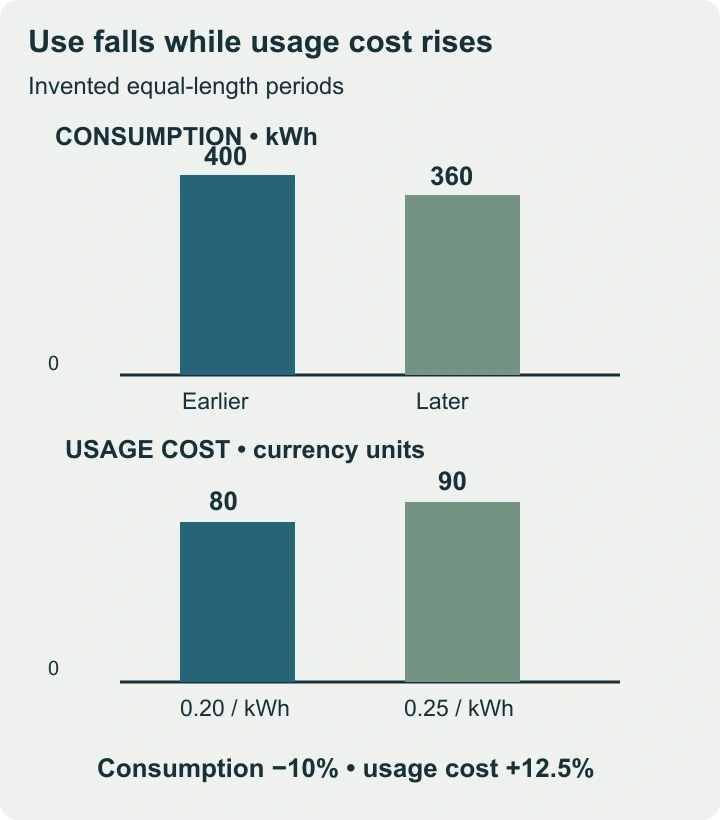
Consider two hypothetical equal-length periods. In the first, a household uses 400 kWh at 0.20 currency units per kWh. In the second, it uses 360 kWh at 0.25. Usage costs are 80 and 90 respectively, excluding fixed charges, taxes and discounts.
| Question | Calculation | Conclusion |
|---|---|---|
| Did consumption decrease? | (400 − 360) ÷ 400 × 100. | Yes, by 10% across these equal-length periods. |
| Did usage cost decrease? | (90 − 80) ÷ 80 × 100. | No, it increased by 12.5%. |
| What is the reduction worth at the old unit price? | 40 × 0.20. | 8 currency units at a constant price. |
The household usage-cost calculator separates these quantities. It does not establish why consumption changed and does not include every charge on a real bill. Check the actual tariff structure before using its result for budgeting.
Period length can change the conclusion too. If the 400 kWh were used over 30 days and the 360 kWh over 28 days, daily averages would be about 13.33 and 12.86 kWh. That is a reduction of about 3.6% per day, not 10%. Daily averaging corrects the period length; it still does not correct weather, occupancy or appliance use.
Choose an action you can carry out and evaluate
Write down the problem before listing products to buy. “The spare room is heated during long periods when nobody uses it” leads to questions about schedules and controls. “We discard half a bag of salad each week” leads to shopping and meal-planning questions. “I want a more sustainable home” is too broad to show what the next action should be.
For building problems, the US Department of Energy’s home-energy-assessment guidance recommends evaluating the home and using the findings to prioritize improvements. Work affecting electrical systems, ventilation or combustion needs appropriate qualified advice. Do not block a vent or change equipment merely to make a consumption figure fall.
Separate actions into things you can do now, things needing permission and things needing investigation. A renter can document a leak or report a faulty control without being able to replace the system. That is still a concrete step.
Work through a food-waste problem
Suppose a household’s seven-day log records 1.2 kg of food that was intended to be eaten but was discarded: 0.5 kg of unused produce, 0.4 kg of uneaten prepared food and 0.3 kg of bread. These are invented observations. The useful next step is to identify the recurring reason, not simply to promise to waste less.
If produce is bought for meals that rarely happen, buy for the number of meals realistically eaten at home. If bread remains unused, consider buying a smaller amount or freezing a suitable portion while it is still in good condition. EPA guidance supports checking existing supplies, planning quantities and using appropriate storage to prevent waste.
Continue the same log during a second comparable week. If the measured amount falls to 0.7 kg, the observed reduction is 0.5 kg, or about 41.7%. That is a result for these two weeks under the recorded conditions. It is not proof of the same percentage saving over a year, and it is not a percentage reduction in the household’s total environmental impact.
Keep food safety intact. A waste-reduction plan should help prevent food becoming unsafe, not encourage eating questionable food to improve the log. Use appropriate storage and official food-safety guidance for the items concerned.
Use the month to learn, not to promise instant transformation
| Stage | Work | Decision or record |
|---|---|---|
| Observe | Collect bills or keep a short log of one recurring issue. | Baseline, dates, units and missing information. |
| Choose | Identify an action within your control and its practical cost. | What will change, who is responsible and what success means. |
| Try | Carry out the change while recording relevant conditions. | Consumption or waste measure, plus comfort and practicality. |
| Review | Compare suitable periods and investigate unexpected results. | Keep, adjust, stop or investigate further. |
The stages need not occupy exactly one week each. A shopping pattern may become visible quickly, while seasonal heating cannot be judged fairly from a few mild days. If the observation period is unsuitable, extend it rather than declaring success because the calendar month has ended.
When several changes happen together, the combined outcome may still matter, but assigning it to one action becomes harder. Record the whole bundle. A new appliance, a holiday and warmer weather in the same period do not provide a clean test of the appliance alone.
Evaluate a purchase with its assumptions visible
If an optional measure costs 60 currency units and is expected to save 8 per comparable month, simple payback is 60 ÷ 8 = 7.5 such months. That calculation ignores finance costs, maintenance, changed prices and any difference in future use. A seasonal measure does not necessarily deliver that saving every month of the year.
Ask whether a repair, maintenance task or change in routine addresses the problem before replacing working equipment. When a replacement is needed, compare the service it provides as well as its consumption. A product that uses less energy but does not meet the household’s actual needs may lead to supplementary use elsewhere.
Do not treat a money-saving estimate as a complete environmental assessment. The production of replacement equipment, its expected service life and disposal may matter too. If you lack those data, describe the decision in the narrower terms you can support.
Keep comfort, access and extra work in the review
Record whether the change is practical for everyone affected. A reduction achieved by leaving someone uncomfortably cold is different from improving a building’s performance. A shopping plan that requires several extra journeys or excessive preparation may be difficult to maintain.
For travel, distinguish combining a trip from merely moving it. If an errand is added to an existing journey, record any detour before claiming the whole original trip was saved. Distance is a useful first measure; an emissions estimate needs additional assumptions about the vehicle, fuel and travel conditions.
For waste, distinguish prevention from disposal. Avoiding unnecessary food purchases reduces the amount entering the waste stream; composting changes what happens to some material after it becomes waste. Both can be relevant, but they should not be counted as the same action.
Finish with a short decision note
A useful note says what changed, what was observed, what else may explain the result and what happens next. For the fictional food example: “Bought produce for four planned meals rather than seven. Logged edible food discarded fell from 1.2 to 0.7 kg over two recorded weeks. One evening meal moved outside the home in the second week. Continue the revised list and review again.”
That note is more informative than “the household is 42% greener.” It preserves the evidence without stretching it. Choose the next problem after reviewing the first, using what you learned about the home and the people who live there.