Better sleep: understand your schedule, keep a useful diary and know when to get help
Better sleep starts with identifying the difficulty you actually have. Too little time available for sleep, trouble sleeping despite enough opportunity, an irregular schedule and persistent daytime sleepiness are different problems. A useful routine addresses the relevant problem; it does not require chasing a perfect wearable score or buying a collection of sleep products.
This guide is for adults and provides general education, not an individual diagnosis or treatment plan. If sleepiness makes driving or another hazardous activity unsafe, stop that activity and arrange a safe alternative. Persistent sleep problems, or snoring accompanied by gasping or observed breathing pauses, deserve a healthcare assessment.
Look at opportunity, timing and daytime functioning together
Start with three questions.
- How much time does your schedule leave for sleep?
- How consistent is that opportunity?
- How do you function after it?
Someone sleeping from 1 a.m. to 6 a.m. faces an obvious scheduling constraint. Someone allowing eight hours but spending much of it awake needs a different conversation.
The CDC recommends at least seven hours for adults aged 18–60, seven to nine hours for ages 61–64 and seven to eight hours for ages 65 and older. These population recommendations are a starting point, not a rule that everyone should obtain precisely the same number of hours.
| Pattern | Useful first question | What not to conclude |
|---|---|---|
| Bedtime is late because work and travel fill the evening | Which obligation could change to create more opportunity? | That poor motivation is the only explanation |
| Enough time is available but sleep is repeatedly difficult | How long has this lasted, and what symptoms accompany it? | That simply spending longer in bed will solve it |
| Timing changes substantially between days | Which parts of the schedule can realistically become more consistent? | That a generic bedtime fits shift work or caregiving |
| Sleep seems sufficient but daytime sleepiness persists | What should a clinician assess beyond the diary? | That a reassuring device score rules out a problem |
Eight hours in bed can mean less than eight hours asleep
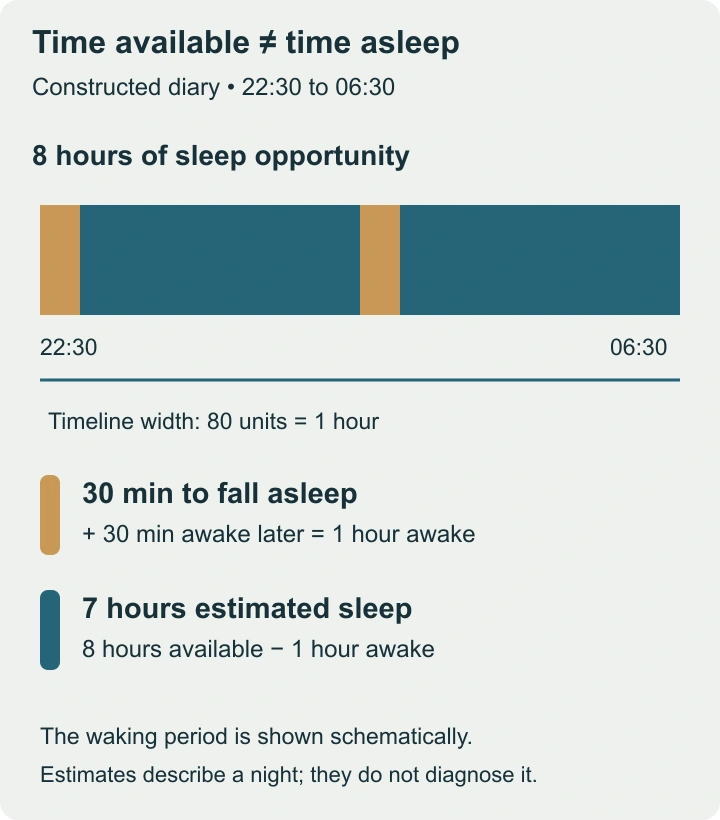
Consider a fictional entry: lights out at 10:30 p.m., approximately 30 minutes to fall asleep, about 30 minutes awake later in the night, and getting up at 6:30 a.m. The interval is eight hours. Subtracting the estimated waking time leaves roughly seven hours asleep.
This is descriptive arithmetic, not a diagnostic threshold. The person may estimate waking time imperfectly, and the same total can arise from different patterns. One long waking period and several short awakenings can feel different even if their recalled durations add to the same number.
Keep the estimate simple enough to use. If you repeatedly look at the clock to obtain exact minutes, the record can become an additional source of frustration. Approximate recollections and a brief note about the daytime effect are usually more useful for a conversation than elaborate precision you cannot support.
Use a short diary to reveal a question
For seven ordinary days, note the intended sleep period, approximate time asleep, major interruptions and how alert you felt during the following day. Include workdays and days off if possible. Note caffeine or alcohol timing, relevant medication changes, illness, travel and caregiving interruptions. You do not need to decide which factor caused a problem before recording it.
| Night | Opportunity | Estimated sleep | Context to retain |
|---|---|---|---|
| Monday | 11:30 p.m.–6:30 a.m.: 7 hours | 6 hours 20 minutes | Late work; sleepy during the commute |
| Tuesday | 10:30 p.m.–6:30 a.m.: 8 hours | 7 hours | About one hour awake in total |
| Saturday | 1 a.m.–9 a.m.: 8 hours | 7 hours 30 minutes | Later timing than workdays |
The first entry suggests limited opportunity. The second distinguishes opportunity from sleep obtained. The third shows a timing change. Three entries cannot diagnose the person, but they make the next questions more concrete than “I never sleep well.” Use the seven-day sleep record to prepare a concise account.
Choose an adjustment that addresses the constraint
NHLBI guidance supports a regular schedule and a quiet, dark sleep environment, and advises attention to caffeine, alcohol and stimulating activities near bedtime. Translate that into one feasible change rather than a rigid collection of rules.
For someone who loses an hour to avoidable late work, the experiment might be an agreed stopping time and preparing tomorrow’s essentials earlier. For someone interrupted by household noise, it might be negotiating a quieter period. A person working rotating shifts may need help from their employer or clinician to plan a workable sleep schedule; copying a daytime worker’s bedtime is unlikely to address the real constraint.
Record the intended change and the result without treating one good night as proof. “Stopped work at 9 p.m.; felt less rushed; still woke twice” is useful. It preserves both an improvement in the evening and a remaining sleep difficulty. If the change proves unrealistic, revise the plan instead of treating that as a personal failure.
Discuss medicines and sleep aids with the right professional
Record the timing of substances that may affect your sleep, but do not stop prescribed medicine on your own. A pharmacist or clinician can review the product, dose and timing in the context of your health. Alcohol is not a dependable treatment for a sleep problem.
NHLBI notes that over-the-counter sleep products and supplements also belong in this discussion. “Available without a prescription” does not establish suitability for every person. This article does not recommend a medicine, supplement dose or self-directed sleep-restriction program.
Know when a diary should lead to assessment
Loud snoring, breathing that repeatedly stops and starts, gasping and daytime sleepiness are among the symptoms NHLBI identifies for sleep apnea. They are reasons to describe the pattern to a healthcare professional, not a basis for diagnosing yourself from a checklist. Some people learn about their nighttime symptoms from someone else.
Bring a brief summary: when the difficulty began, typical work and sleep hours, how it affects functioning, any observed breathing symptoms and relevant medicines or health changes. Mention near-misses while driving or difficulties staying awake at work directly. Do not postpone help until the diary is complete if safety is already affected.
For long-term insomnia, NHLBI describes cognitive behavioral therapy for insomnia, or CBT-I, as a usual first treatment option. It is a structured treatment that addresses more than bedroom habits. Its components and suitability should be discussed with a qualified professional, especially when other conditions or safety-sensitive work are involved.
Let tracking support the conversation
A wearable may make a schedule easier to notice, but its output should remain one piece of information. A device cannot establish from a favorable score that a symptom is harmless. If its estimate disagrees with your recollection, retain that disagreement rather than rewriting the diary to match the device.
A useful seven-day review ends with a specific next step: protect more sleep opportunity, address an avoidable interruption, ask about a work constraint or arrange assessment. The goal is a workable pattern and safer daytime functioning. More elaborate tracking is worthwhile only if it helps you and the appropriate professional understand that task.