Lyndon B. Johnson’s domestic legacy: laws, coalitions and unfinished outcomes
Lyndon B. Johnson’s domestic legacy rests on an unusually concentrated period of federal lawmaking. Civil rights, voting rights, education, health insurance and antipoverty initiatives changed what the federal government undertook to protect or provide. Understanding that record requires more than listing achievements: it requires examining the coalitions that enacted them, the mechanisms they created and the distance between a law’s promise and its implementation.
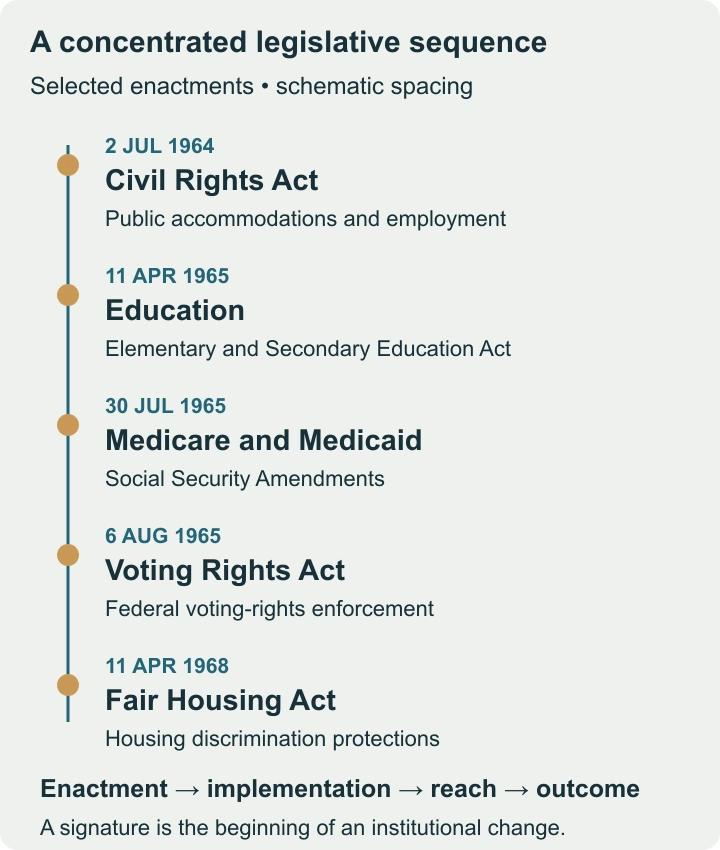
The historical address of this page places Johnson in a partisan comparison. A more durable assessment begins with specific institutions and decisions. Johnson was central to the legislative record, but presidents do not create social movements, congressional votes or administrative outcomes by themselves.
The central legislative sequence
| Date | Law | Central domestic significance |
|---|---|---|
| 2 July 1964 | Civil Rights Act | Major federal prohibitions on discrimination, including in public accommodations and employment |
| 20 August 1964 | Economic Opportunity Act | Created the Office of Economic Opportunity for federal antipoverty efforts |
| 11 April 1965 | Elementary and Secondary Education Act | Expanded federal support for elementary and secondary education |
| 30 July 1965 | Social Security Amendments | Established Medicare and Medicaid |
| 6 August 1965 | Voting Rights Act | Added powerful federal measures against racial discrimination in voting |
| 11 April 1968 | Fair Housing Act, within the Civil Rights Act of 1968 | Prohibited major forms of discrimination in housing |
These dates mark enactment. They are not dates on which every eligible person received a service or every prohibited practice disappeared. The timeline also selects only part of the administration’s domestic record; environmental, immigration, cultural and other legislation require their own examination.
Civil rights: presidential leadership within a wider struggle
The Civil Rights Act of 1964 addressed different institutions through different provisions. Title II concerned covered public accommodations; Title VII addressed employment discrimination. Other titles dealt with subjects including public facilities, education and federally assisted programs. Treating the law as a single general declaration misses the legal machinery through which it could change conduct.
The measure also had a history before Johnson signed it. Kennedy had proposed civil-rights legislation in 1963, while civil-rights organizing and protest created sustained pressure for federal action. Johnson’s role was to use the presidency to advance a measure whose passage still depended on Congress. This is an account of interacting sources of power, not a choice between crediting a president and recognizing the movement.
The Senate’s procedural record shows why a simple party label is inadequate. On 10 June 1964, 44 Democrats and 27 Republicans voted for cloture, producing a 71–29 vote to end the filibuster. That was the vote to limit debate. The Senate’s final passage vote on 19 June was 73–27. Mixing the two counts confuses the mechanism that enabled passage with passage itself.
Southern Democratic opposition, Democratic supporters and Republican votes all belong in the explanation. A later political argument that assigns the entire achievement or opposition to one present-day party identity loses the coalition that actually operated in 1964.
Voting rights: changing enforcement, not only stating a principle
The Voting Rights Act of 1965 addressed the obstruction of Black voting rights through federal enforcement mechanisms. As enacted, it provided for federal examiners in covered jurisdictions and required federal review of proposed voting changes in those jurisdictions. Its nationwide prohibition on racial discrimination in voting and its targeted oversight provisions did different work.
The National Archives’ account connects passage to organizing, violence against voting-rights workers and the attack on peaceful marchers at Selma. Johnson’s political efforts mattered within that sequence. The law was a response to the inadequacy of relying on formal rights while local practices prevented their exercise.
For historical evaluation, ask whether people could register and participate, whether obstructive practices could be challenged and whether federal enforcement reached the places where it was needed. Enactment is evidence of institutional change; implementation evidence establishes what that change accomplished. The original 1965 arrangements should not be described as if all of them remained unchanged today.
Medicare and Medicaid created distinct routes to coverage
The Social Security Amendments signed on 30 July 1965 established two programs that are often mentioned together but were not identical. Medicare initially centered on older Americans and included hospital insurance and supplementary medical insurance. Medicaid developed as a federal-state program, initially connected to categories of people receiving cash assistance. It was not simply Medicare for everyone below an income threshold.
The Centers for Medicare & Medicaid Services records that eligibility and benefits changed over time. Later expansions should not be credited to the original act as if every feature existed in 1965. Historical evaluation needs to distinguish the original institutional foundation from the program that subsequent laws produced.
Three questions help clarify the achievement: who became eligible, what services the program financed and whether people could actually obtain those services. An insurance entitlement and practical access are related, but a person’s experience also depends on providers, administration and the terms of coverage. This distinction allows a substantial expansion of federal responsibility to be recognized without implying that all health-care barriers were removed.
Education and antipoverty policy used different tools
Johnson signed the Elementary and Secondary Education Act on 11 April 1965 at the school associated with his own childhood. His signing remarks emphasized urgency in strengthening elementary and secondary education. The act’s significance lay in federal support delivered through an education system that still depended on other levels of government and local institutions.
The Economic Opportunity Act of August 1964 created the Office of Economic Opportunity. The National Archives describes that office as coordinating antipoverty programs. The existence of a coordinating agency matters, but “the War on Poverty” should not be treated as one uniform intervention with one population and one outcome.
- For example, evaluating a training initiative requires questions about participation, completion and later opportunities.
- Evaluating school support requires questions about which students and institutions receive resources and how those resources are used.
Combining every initiative into a single success-or-failure verdict makes it harder to identify what worked, for whom and under which conditions.
A fall in a national poverty rate during a period of reform is important descriptive evidence, but it is not by itself a complete estimate of a program’s causal effect. Economic conditions, employment, demographic changes and the chosen poverty measure also matter. A careful account can recognize ambitious federal action while requiring stronger evidence for claims about how much of an outcome it caused.
Fair housing shows why passage and enforcement must be separated
Johnson signed the Fair Housing Act on 11 April 1968. The Justice Department’s historical account describes a difficult legislative path and the development of federal enforcement after passage. Prohibiting discriminatory housing practices was a major legal step; making those protections usable required complaints, investigation, enforcement and subsequent institutional work.
This is a useful test of how to assess any landmark law. A signature establishes a new rule and its intended scope. It does not immediately demonstrate equal access in every housing market. Conversely, the persistence of inequality does not establish that the legal change had no effect. The evaluation must examine the mechanism and its outcomes rather than selecting one observation as a verdict on the whole reform.
A framework for judging the record without flattening it
| Level | Historical question | Evidence to examine |
|---|---|---|
| Enactment | What changed in federal authority or obligation? | Statutory text, dates and legislative votes |
| Implementation | How did institutions put the law into practice? | Administrative records, budgets and enforcement history |
| Reach | Who actually gained access or protection? | Participation, coverage and geographic distribution |
| Outcome | What improved, and what remained unequal? | Comparable measures over time and research on causes |
This framework avoids both hero worship and dismissal by an impossible standard. A reform can be consequential without solving an entire problem. It can also deserve criticism where its design or implementation leaves people outside its protection. Those judgments become more convincing when they identify the particular mechanism instead of treating “the Great Society” as an indivisible object.
Vietnam belongs in the assessment of the presidency
Johnson’s domestic record cannot stand in for an assessment of his entire presidency. In his 31 March 1968 address, he announced steps to limit the war in Vietnam and said he would neither seek nor accept his party’s nomination for another term. The speech is a primary record of his public position at that moment, not a neutral explanation of every cause or consequence of the war.
The domestic laws should be evaluated on their content and effects; the war requires its own accounting of decisions, responsibility and human consequences. Recognizing one record does not cancel the other. A defensible judgment of Johnson keeps both in view and remains specific about what is being praised, criticized or left unresolved.