Paul Ryan and Rage Against the Machine: the 2012 dispute
In August 2012, Paul Ryan’s reported enthusiasm for Rage Against the Machine became a campaign story when guitarist Tom Morello challenged the politics behind it. The disagreement had a specific setting. Ryan had just joined Mitt Romney’s presidential ticket, and his proposals for the federal budget were already prominent in national debate. Morello argued that those priorities conflicted with the political purpose of his music.
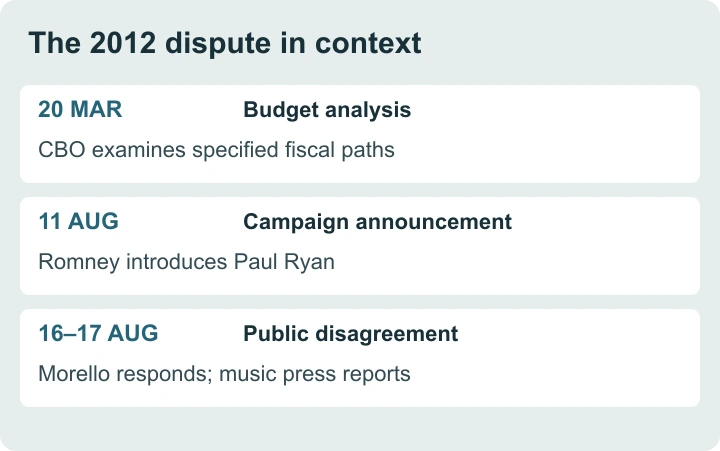
The episode is most revealing when the campaign announcement, the musician’s objection and the policy record are read together. Each explains a different part of why a preference in music became a public argument.
The campaign context in August 2012
Romney introduced Ryan as his running mate on August 11, 2012. In the announcement speech preserved in the NPR transcript published by KPBS, Romney presented Ryan’s experience with budgets as a reason to trust him with the economy. He also made the case for private enterprise, presenting government’s role as creating conditions in which people and businesses could succeed.
That helps explain why the story travelled beyond music coverage. Ryan was entering a highly visible national role with an identifiable argument about government and economic responsibility. A favourite band became an easy way to ask whether his cultural tastes fitted that public identity.
| Date | Document or event | What it establishes |
|---|---|---|
| March 20, 2012 | CBO published an analysis of fiscal paths supplied by Ryan and his staff. | The budget programme was a substantive policy issue before the music dispute. |
| August 11, 2012 | Romney announced Ryan as his running mate. | Ryan’s record and public identity became part of the presidential campaign. |
| August 16–17, 2012 | Morello’s Rolling Stone essay appeared, followed by contemporary music coverage. | The guitarist publicly rejected the political affinity that readers might infer from Ryan’s reported fandom. |
What Morello objected to
Morello’s essay appeared in Rolling Stone on August 16. NME’s report the following day reproduced passages in which he challenged Ryan’s economic priorities and questioned how they could be reconciled with the band’s message. His objection centred on power and distribution, especially his belief that Ryan’s programme favoured the wealthy.
One short sentence captures an important qualification in the essay:
“He can like whatever bands he wants”
Morello’s argument allowed personal enjoyment while disputing political compatibility. This makes the controversy more specific than an artist simply objecting to an unwanted fan. The dispute concerned what it meant for a prominent politician to identify with a band whose public message the guitarist understood as opposing that politician’s priorities.
The criticism is Morello’s political judgement. Treating it as an attributed argument lets readers examine it without converting the musician’s characterisation into an established finding about every effect of Ryan’s proposals.
The budget proposal gives the disagreement substance
The Congressional Research Service’s March 29, 2012 overview of Ryan’s FY2013 budget proposal describes major changes proposed for Medicare and Medicaid. For people becoming eligible for Medicare from 2023, the proposal envisaged a choice of private coverage or a traditional fee-for-service option through a Medicare exchange. It also proposed converting federal Medicaid financing into a block grant to states. These were proposals described in a 2012 document.
The financing distinction matters. A programme’s budget can change because of who qualifies, how providers are paid, how much government contributes or which institution bears additional costs. Calling all of those choices “smaller government” leaves their practical effects unexplained. For Medicaid, moving towards a defined federal grant raises questions about how funding responds when state needs or healthcare costs grow.
CBO’s March 20 analysis has a further limitation worth preserving. The agency evaluated revenue and spending paths specified by Ryan and his staff against alternative fiscal trajectories. Its projections were conditional on those inputs. A projected reduction in federal debt and a judgement about the fairness of a programme address different questions.
This provides a concrete way to understand the disagreement. Romney’s campaign framed budget experience and limits on government as strengths. Morello viewed Ryan’s priorities through their implications for economic power and people with fewer resources. The policy documents explain the proposed mechanisms. The speakers’ statements explain the values they brought to them.
Why liking the music does not settle the argument
A listener can respond to rhythm, guitar playing, a memory or the physical energy of a performance. An artist can give political meaning to the same work. Those experiences can coexist, but they do not answer the same question about a politician.
In this case, a claim about listening preference cannot establish an artist’s support for a campaign. Equally, the artist’s objection does not tell us precisely why a particular listener enjoys a recording. The evidence supports a public disagreement over political identification. Any stronger claim needs its own record.
| Claim | Relevant evidence | Limit |
|---|---|---|
| Ryan liked the band. | Contemporary reporting of his musical preference. | This describes reported taste, with no automatic inference about agreement. |
| Morello opposed Ryan’s politics. | The guitarist’s public response. | Attribute the judgement to its speaker and its 2012 context. |
| The budget would have particular effects. | The proposal’s details and analysis of its assumptions. | A musician’s criticism or a campaign speech alone cannot establish the outcomes. |
How a music preference becomes a campaign signal
Consider the difference between two hypothetical descriptions of a candidate.
- “She listens to this band while exercising” describes an activity.
- “She shares this band’s politics” makes an additional claim about beliefs.
The second statement needs evidence about the candidate’s positions and the band’s expressed views.
The Ryan–Morello story became compelling because that extra inference was easy to make and easy to challenge. A reader could recognize a tension before opening a budget document. The more demanding question was whether the tension illuminated an actual policy disagreement. The answer depends on connecting the cultural reference to specific proposals, rather than treating musical taste as a complete political biography.
For a retrospective, the strongest reading stays with that connection. August 2012 brought a newly announced vice-presidential candidate, an existing budget debate and a musician willing to contest the public meaning of his work. The episode shows how political art can become part of electoral argument even when the initial connection is a reported listening preference.