The Affordable Care Act in 2013: what was changing and what the terms meant
The Affordable Care Act changed the rules for obtaining and paying for health coverage, but it did not turn every insurance plan into the same product. For someone reading the news in 2013, the essential distinction was between the law, the marketplace where coverage could be selected, and the particular insurance contract a household would use.
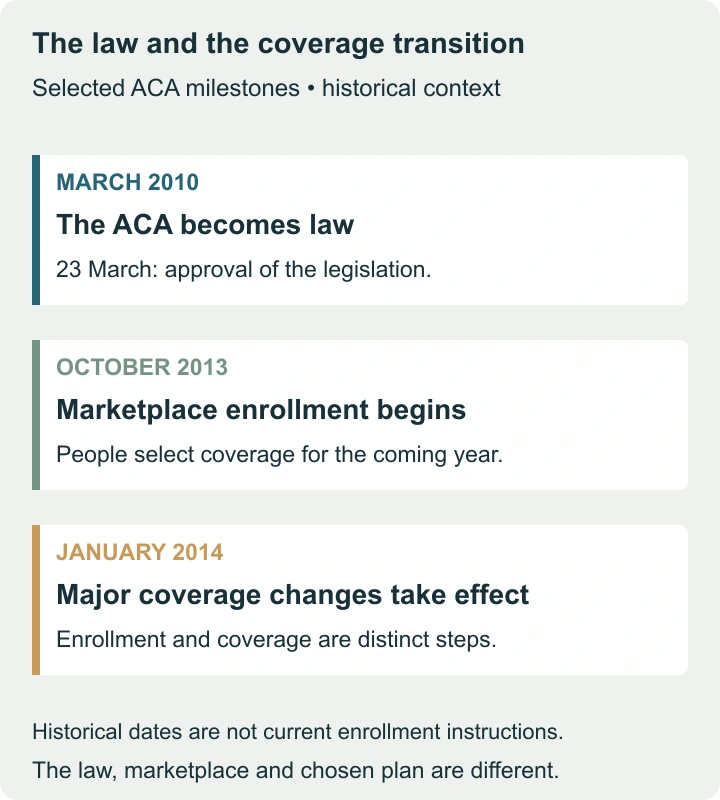
This guide explains that historical transition and the insurance terms needed to understand it. It does not provide current enrollment dates, subsidy amounts or an individual eligibility determination. Those depend on the coverage year, the household and the applicable rules.
What happened in 2010, 2013 and 2014?
The Patient Protection and Affordable Care Act was approved on 23 March 2010. Its provisions did not all begin that day. Marketplace enrollment opened in October 2013 for coverage beginning in 2014, when major changes to individual coverage took effect. The long transition helps explain why a 2013 article could describe both protections already operating and changes still ahead.
A contemporary notice to people in the federal Pre-Existing Condition Insurance Plan illustrates the practical challenge. It directed them toward marketplace enrollment for 2014 and explained that they would not simply be transferred into a new marketplace policy. The useful historical lesson is that an available coverage route still required enrollment steps. Instructions and deadlines in a dated notice should not be reused as current guidance.
| Term | What it describes | What it does not establish |
|---|---|---|
| The ACA | A federal law with multiple coverage and insurance provisions | The price or network of one person’s plan |
| A health insurance marketplace | A route for comparing and enrolling in coverage and assessing eligibility for financial help | A guarantee that every listed plan has the same doctors or cost sharing |
| An insurance plan | A specific contract defining covered benefits, payment rules and other terms | Free access to every service or every provider |
What did protection for pre-existing conditions mean?
For ACA-compliant individual coverage, including marketplace plans, a person’s pre-existing health condition cannot be used to deny coverage or charge more on that basis. This addressed a major obstacle for people seeking individual insurance. It is a rule about access to coverage and pricing based on health status, not a promise that every possible treatment is covered.
The policy still has a benefits design. A person with an ongoing condition needs to check the relevant clinicians, medicines, facilities and authorization requirements. “The plan must accept me” and “this exact service is covered under these conditions” are different questions. Both matter.
Product scope matters as well. HHS identifies a pre-existing-condition exception for grandfathered individual policies. Other products marketed alongside comprehensive insurance should not be assumed to have all the same protections. When reading a comparison, establish what kind of product is being described before applying a rule to it.
The five cost terms that determine what a household pays
Start with the premium: the payment for maintaining coverage. Then distinguish payments associated with using care. The definitions below are a reading aid; the policy and its Summary of Benefits and Coverage provide the terms for the actual plan.
| Term | Meaning | Common mistake |
|---|---|---|
| Premium | The recurring price of coverage | Counting it toward the deductible automatically |
| Deductible | An amount you pay for services subject to that deductible before the plan begins sharing those costs | Assuming every service must meet it first |
| Copayment | A specified amount for a covered service under the plan’s rules | Treating it as a percentage |
| Coinsurance | Your percentage share of an applicable covered cost | Applying it to an arbitrary billed price instead of the relevant allowed amount |
| Out-of-pocket limit | A cap on specified cost sharing for covered care under the plan’s rules | Assuming premiums, noncovered services and every out-of-network charge are included |
A provider’s billed charge and an insurer’s allowed amount can differ. If a hypothetical covered service has an allowed amount of $200 and your applicable coinsurance is 20%, the percentage calculation is $40. Whether a deductible must first be met, or a different copayment applies, still depends on the plan. A single percentage printed in a comparison is not a complete estimate.
Two fictional plans: why the lowest premium may not mean the lowest total
Suppose two plans cover the same illustrative care, from the same in-network providers, over a full twelve-month year. All spending in this simplified model is subject to one deductible, followed by coinsurance. There are no copayments, subsidies or noncovered charges in the model, and neither scenario reaches the applicable out-of-pocket limit. These are constructed figures, not quotations for real coverage.
| Feature | Plan A | Plan B |
|---|---|---|
| Monthly premium | $200 | $300 |
| Twelve-month premiums | $2,400 | $3,600 |
| Deductible | $1,500 | $500 |
| Coinsurance after deductible | 20% | 10% |
With $500 of allowed covered spending, both people pay that $500 themselves in this model. Total annual premiums plus modeled cost sharing are therefore $2,900 for A and $4,100 for B. A costs $1,200 less.
With $8,000 of allowed covered spending, A’s cost sharing is $1,500 + 20% × $6,500 = $2,800. Adding premiums gives $5,200. B’s cost sharing is $500 + 10% × $7,500 = $1,250. Adding premiums gives $4,850. B now costs $350 less.
The result changed because the additional premium bought a different cost-sharing structure. It did not establish which plan is universally better. If a needed clinician is outside one network, a medicine is treated differently, or real care uses copayments and exceptions, the comparison must be rebuilt. A high-cost scenario should also apply each plan’s actual out-of-pocket rules instead of extending coinsurance indefinitely.
Premium help and help with cost sharing solve different problems
CMS describes premium tax credits and cost-sharing reductions as separate forms of marketplace assistance. Premium assistance lowers the cost of maintaining qualifying coverage. Cost-sharing reductions, when the applicable eligibility and plan-selection requirements are met, reduce specified costs of using care. Eligibility for one should not be casually treated as proof of eligibility for the other.
This distinction changes a household budget. Someone may manage the monthly premium but still struggle with the amount due when care is needed. Another household may face an unaffordable premium before any service is used. Comparing only the sticker premium misses that difference. For an actual application, income, household details and access to other coverage need to be assessed under the rules for that year; historical thresholds cannot settle a present-day case.
How to read a plan comparison in a useful order
- Check essential access. Identify the clinicians, facilities and medicines that matter, then verify their treatment under each specific plan.
- Record the recurring cost. Separate the listed premium from any assistance actually determined for the household.
- Read the cost-sharing rules. Note which services use a deductible, copayment or coinsurance and whether different categories have different treatment.
- Build more than one scenario. Compare a modest-use year with a higher-use year, using the same assumed services in both plans.
- Check exposure and exclusions. Identify the applicable out-of-pocket limit and costs that do not count toward it.
- Confirm enrollment and effective coverage. A saved application or a chosen plan is not, by itself, proof that every required step is complete.
The ACA’s historical significance and the arithmetic of one policy answer different questions. Understanding the law explains why the coverage route changed. Reading the actual contract explains how a household would use that route. Keeping those tasks separate makes the subject more understandable without pretending that insurance choices can be reduced to one headline price.