Four Middle East issues as of 17 February 2022: conflict, diplomacy and economic collapse
By 17 February 2022, four different problems demanded attention: continuing violence in Syria, escalation in Yemen with consequences beyond its borders, deterioration in the Israeli–Palestinian situation, and Lebanon’s economic collapse. Treating them as a single regional crisis obscures both their causes and the choices facing people living through them.
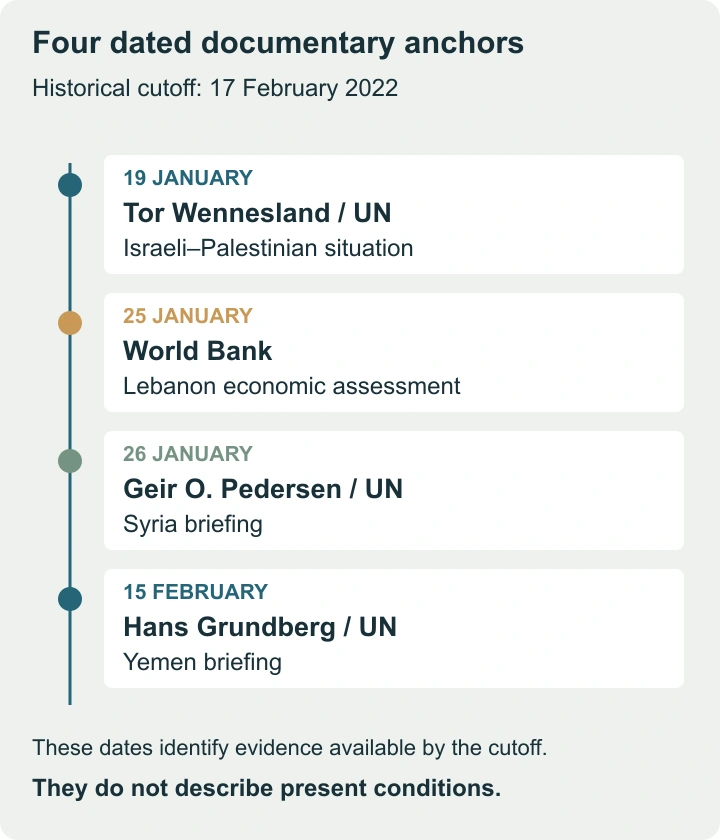
This is a newly written retrospective with that date as its cutoff. It examines four selected issues through contemporary UN briefings and the World Bank’s assessment of Lebanon. It is not a reconstruction of a missing original article, a ranking of every regional emergency, or an account of current conditions.
Four problems that require different questions
| Situation | Contemporary concern | Question that gets beyond the headline |
|---|---|---|
| Syria | Continued violence and a stalled political settlement | Which location and armed actors does a reported change actually concern? |
| Yemen | Military escalation and cross-border attacks | Does an announced diplomatic step reduce threats to civilians in practice? |
| Israeli–Palestinian situation | Violence, settlement activity and pressure on Palestinian institutions | Are immediate security measures accompanied by a credible political direction? |
| Lebanon | Economic contraction and deterioration of essential services | Who bears the losses, and what can households actually buy or access? |
Syria: territorial patterns did not mean that violence had ended
In his 26 January 2022 Security Council briefing, UN Special Envoy Geir O. Pedersen described violence in several parts of Syria, including reported air strikes in Idlib, shelling across front lines, explosive-device attacks and continuing ISIL activity. His account challenged any assumption that a broadly familiar conflict map meant a stable or acceptable situation.
The distinction matters because a map usually records control of territory, while families experience access to a road, a functioning school, a safe home or the possibility of returning after displacement. A boundary can remain in approximately the same place while the risks of living near it change sharply. Conversely, a local reduction in fighting cannot by itself establish nationwide security.
A useful reading of a Syria report therefore starts at the incident level: where did it happen, when, what is known about the people harmed, and how was responsibility described? “Attributed to,” “claimed by” and “independently established” represent different evidence. Removing those distinctions makes a sentence sound firmer while making the account less reliable.
The political question is separate from the incident count. Fewer attacks during one reporting period would be welcome, but they would not alone establish agreement on governance, accountability or the conditions for a durable settlement. Progress needs to be described by its actual scope: a local security development, a humanitarian arrangement or a political commitment.
Yemen: escalation crossed borders, while civilian protection remained immediate
On 15 February 2022, UN Special Envoy Hans Grundberg told the Security Council that recent escalation had highlighted the conflict’s regional dimension. He referred to January attacks by Ansar Allah, also known as the Houthis, on the United Arab Emirates, including civilian airport and industrial areas, in which three civilians were killed. He also described efforts to initiate a political process.
At the same meeting, UN humanitarian chief Martin Griffiths described severe civilian consequences inside Yemen, including harm to homes and civilian infrastructure. These were connected concerns, but they were not interchangeable: an account of cross-border attacks could not substitute for an account of the conditions experienced by people inside the country.
When evaluating a proposed reduction in violence, ask what the arrangement covers. Does it address air strikes, ground fighting, cross-border attacks or particular locations? Who is participating? How would a reported violation be examined? A broad headline about de-escalation may conceal a narrow undertaking.
Consider an illustrative distinction, not a claim about an actual agreement: a commitment to stop one category of attack would not automatically reopen a blocked route or restore a damaged water system. The security commitment and the civilian outcome would each need evidence. This is why tracking political announcements alongside access to essential services gives a more useful picture than counting meetings alone.
The Israeli–Palestinian situation: immediate danger and the political horizon
UN Special Coordinator Tor Wennesland’s 19 January 2022 briefing warned of deterioration in the occupied Palestinian territory across political, economic and security conditions. He discussed violence, including settler violence, and the implications of settlement activity, demolitions and evictions for a negotiated solution. He also highlighted the Palestinian Authority’s financial difficulties and risks to its institutions and services.
Those concerns operated on different timescales. Preventing immediate harm to Israeli and Palestinian civilians required attention to specific threats. Maintaining institutions and services concerned everyday continuity. A negotiated political outcome involved questions that could not be resolved simply by a temporary fall in reported violence.
It is useful to separate these layers when reading a claim of improvement. A measure that eases one financial pressure may help maintain a service without resolving a political dispute. A new diplomatic meeting may create an opportunity without changing conditions on the ground. Neither observation makes the measure worthless; it defines what it has and has not accomplished.
Descriptions also need a clear unit of analysis. A statement about one locality should not silently become a statement about all Israelis or all Palestinians. Governments, political organizations, armed groups, residents and civil-society organizations have distinct roles. Naming the relevant actor is more informative than using a population as shorthand for a decision it did not collectively make.
Lebanon: read the contraction figures without mixing measures
The World Bank’s statement dated 25 January 2022 estimated that Lebanon’s real GDP contracted by 10.5% in 2021, following a 21.4% contraction in 2020. Its accompanying assessment argued that policy failures and the conduct of the country’s elite had deepened the crisis. That is an institutional assessment of responsibility, not a mathematical conclusion that can be extracted from GDP alone.
The two annual percentages should not simply be added. Each applies to a different starting level. The following calculation uses the Bank’s contemporary estimates to explain the arithmetic; it does not replace later national-accounts revisions.
| Step | Calculation | Index level |
|---|---|---|
| Starting point | 2019 = 100 by definition | 100.000 |
| After a 21.4% fall | 100 × 0.786 | 78.600 |
| After a further 10.5% fall | 78.6 × 0.895 | 70.347 |
| Combined fall | 100 − 70.347 | 29.653%, approximately 29.7% |
Real GDP describes inflation-adjusted production. It is not the same as a household’s income, the price of a basket of food, the value of a bank balance or GDP converted into US dollars at a particular exchange rate. A family could face a different change in purchasing power from the change in national output. Those questions need their own measures.
The practical interpretation is therefore broader than “the economy shrank.” Ask which services were available, whether earnings could cover necessities, and how losses were distributed. A national average can establish the scale of contraction while leaving those household differences unresolved.
How to compare developments without creating false certainty
For each issue, keep three separate notes: the documented event, the source’s assessment and your inference.
- A dated briefing establishes what a speaker reported at that time.
- An institutional forecast establishes an estimate, not a final result.
- An announced commitment establishes a promise, not implementation.
Then state what evidence would change the assessment. For a local security claim, that may be a sustained change in verified incidents. For a service-access claim, it may be evidence that people can actually obtain the service. For an economic claim, it may be a revised, consistently defined series. This approach preserves the urgency of the four situations while resisting the temptation to make one headline carry more than it can support.