Coca leaf, Bolivia’s 2013 reservation and the later WHO review
Coca leaf and cocaine belong in the same policy discussion, but they are not interchangeable descriptions of a substance or a practice. The distinction matters for understanding Indigenous cultural use, evaluating health claims and interpreting international drug controls. A debate that treats the leaf simply as cocaine misses important context; a debate that treats traditional use as proof of universal safety misses a different set of questions.
This article revisits Bolivia’s 2013 treaty reservation and then examines a clearly separate development: the World Health Organization expert review reported in December 2025. It explains the documents and their scope, rather than providing instructions for consumption, medical treatment or cross-border trade.
Separate the plant, the preparation and the controlled substance
Coca leaves contain cocaine alkaloid, but a leaf is not a purified cocaine product. Preparation, concentration and route of exposure are relevant to evaluating a substance. The presence of a shared constituent does not establish identical effects, and a different preparation does not make every question about risk disappear.
| Subject | Question it raises | Conclusion that does not follow automatically |
|---|---|---|
| The coca plant and leaf | How are cultivation and the natural material treated? | That every derivative has the same status or effects |
| A traditional practice | What cultural meaning, preparation and context are involved? | That all populations and uses have been studied equally |
| A particular marketed preparation | What does it contain, and what claims are being made? | That a traditional name establishes composition or efficacy |
| Cocaine as a controlled drug | What health risks and controls apply to that substance? | That a discussion of the leaf can ignore diversion to illicit production |
These distinctions also prevent an everyday language mistake: “natural” describes an origin, not a clinical result. “Traditional” describes a history or practice, not a standardized dose, product specification or authorization to treat a particular condition.
What Bolivia reserved in 2013
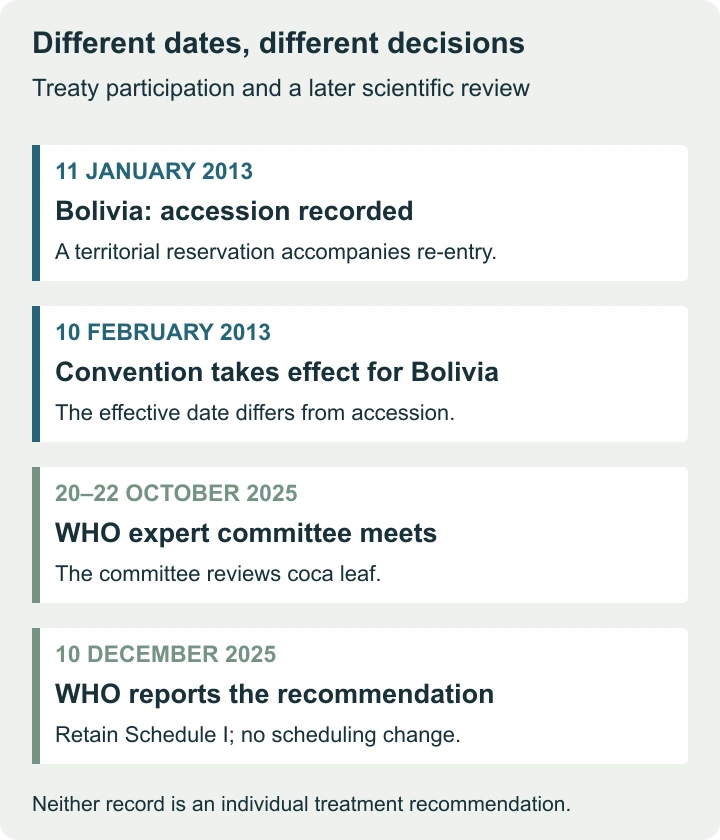
The UN Treaty Collection records Bolivia’s accession to the amended 1961 Single Convention on Narcotic Drugs on 11 January 2013, following its earlier withdrawal. The accession became effective on 10 February 2013. An accession date and the date on which the treaty takes effect for the state are related but distinct milestones.
Bolivia’s reservation concerns specified uses within its own territory: traditional chewing, cultural and medicinal uses of the leaf in its natural state, including infusions, and the cultivation, trade and possession necessary for those lawful purposes. It also affirms measures to control cultivation and prevent abuse and illicit production of narcotic drugs obtainable from the leaf.
The geographic and substantive boundaries are essential. This was not the removal of coca leaf from international schedules worldwide. It was not an unrestricted permission covering every derivative, quantity, commercial claim or destination. A treaty reservation should be read as a defined legal position, not shortened into a slogan about global legalization.
Why the cultural context matters to the policy question
A practice may carry meaning through relationships, customary use and a community’s history. WHO’s later review explicitly acknowledged coca leaf’s cultural and therapeutic significance for Indigenous peoples and other communities. Recognizing that significance is different from assuming that every person in the Andes has the same practice or view.
For a reader, the practical consequence is to ask who is being described. A community discussing customary use, a grower describing a livelihood and a company selling a packaged product are not making the same claim. An account can respect the first two without endorsing the third.
Imagine a hypothetical commercial advertisement that invokes an Indigenous tradition to promote a new concentrated product. The cultural history alone would not establish that the product matches the traditional preparation, that the community endorses it or that its health claims are supported. Those are separate matters requiring separate evidence.
The later WHO assessment: what was actually recommended?
WHO’s Expert Committee on Drug Dependence met on 20–22 October 2025. In its 10 December 2025 account, WHO reported a recommendation to retain coca leaf in Schedule I of the 1961 Convention. The stated rationale included the leaf’s convertibility to cocaine and concerns associated with illicit cocaine production.
WHO also reported that traditional chewing and tea consumption did not pose major public-health risks in the committee’s assessment. That population-level statement is not a guarantee of safety for every individual, preparation or pattern of use. It should not be rewritten as a recommendation to consume coca or to use it instead of medical care.
The committee recognized evidence gaps while recommending no change to the existing international scheduling status. WHO’s publication record subsequently listed the forty-eighth committee report on 24 September 2026. The later publication date does not move the committee meeting into 2026 or make its conclusions part of the 2013 debate.
A scientific assessment and a treaty reservation do different work
| Record or institution | Role in this account | What it cannot establish alone |
|---|---|---|
| UN Treaty Collection | Records treaty participation and the reservation text | Clinical effectiveness of a preparation |
| Bolivia’s reservation | Defines its position concerning specified territorial uses | Import permission in another country |
| WHO expert review | Assesses relevant scientific evidence and recommends scheduling treatment | An individual prescription or endorsement of a retail product |
| National authorities | Apply the relevant domestic rules within their jurisdiction | A universal answer for every other jurisdiction |
A report can be important without deciding every downstream question. For example, a scientific recommendation concerning international scheduling does not itself establish the documentation required for a specific import. Conversely, a restriction does not by itself measure the clinical effects of a particular traditional practice.
How to examine a health claim without confusing recognition and proof
- First identify the exact claim. “Used traditionally for this purpose,” “studied for this outcome” and “shown to be an effective treatment under specified conditions” are different statements. An article should not move from the first to the third without the necessary evidence.
- Then identify the preparation, participants and outcome in the research. A finding about one preparation cannot automatically be applied to another. An observed short-term effect is not the same as evidence about repeated use, interactions or outcomes in groups not studied. A general account cannot determine suitability for an individual with a medical condition or taking medicines.
- Finally, ask what remains unknown. A useful summary can acknowledge a culturally significant practice, distinguish the leaf from purified cocaine and still state that a particular therapeutic claim is unproven. Those positions are compatible. The alternative—forcing every fact into either “harmless” or “identical to cocaine”—produces a less accurate explanation.
Three headline shortcuts to avoid
“Bolivia legalized coca everywhere.” The reservation’s territorial scope contradicts that reading. For a real travel, shipment or purchase question, the applicable destination and transit rules must be checked with the responsible authorities. A historical article is not clearance to move a product.
“WHO proved every coca product safe.” The committee’s assessment concerned evidence and scheduling, with distinctions among uses and remaining gaps. It was not a certification of every commercial formulation or an individualized safety assessment.
“Nothing changed because controls remained.” This also loses information. The 2013 reservation and the later review document different legal and scientific developments even though the latter recommended maintaining the international schedule. An unchanged schedule does not mean that no substantive debate or assessment occurred.
What a careful account should leave you understanding
The 2013 event concerned Bolivia’s treaty participation with a specific reservation. The 2025 review concerned scientific assessment and international scheduling. Cultural recognition, health evidence and legal authorization intersect, but none can stand in for all the others.
When reading another account, look for those boundaries: which material, whose practice, which date, which institution and which jurisdiction? A clear answer can preserve cultural context and acknowledge risk without exaggerating either. That is more useful than an argument built around an undifferentiated word such as “coca.”